

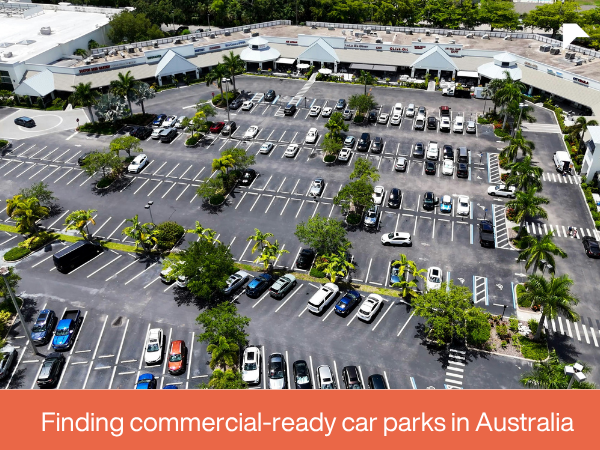
A car park doesn’t need tenants, doesn’t need a fit-out and rarely demands ongoing maintenance. Yet in the right location, it can generate a reliable commercial income.
For investors looking for commercial-grade income without the headaches of tenant management, it’s an asset class worth understanding.
This guide explains what a ‘commercial-ready’ car park looks like, how regulation affects feasibility, and what to check before committing to an asset.
Commercial car park investment models
Commercial car park investments generally fall into three categories.
The first is an individual strata-titled bay, usually purchased outright and leased directly to commuters, nearby businesses or through platforms such as Parkhound. Often available for under $100,000, these represent the lowest-cost entry point into commercial property.
The second is a collection of strata bays held as a portfolio, providing multiple income streams within the one building or precinct.
The third is a dedicated commercial parking facility, ranging from ground-level lots to multi-storey structures. These are typically leased to operators such as Secure Parking, Care Park or Wilson Parking, who manage pricing, staffing, access and day-to-day operations while paying rent back to the owner.
Although the scale varies considerably, each investment relies on the same principle: income is driven by consistent use rather than securing a traditional long-term tenant.
What drives returns?
Like most property investments, car parks live and die by location. Demand is strongest where parking is limited, and people are prepared to pay for convenience.
Sydney and Melbourne CBDs continue to command premium values thanks to constrained supply and dense employment centres, while Brisbane and Adelaide offer lower entry prices and greater potential for long-term growth. In Perth, demand is more concentrated around hospitals, universities and major employment precincts than the CBD itself.
Before buying, always check current occupancy rates, local parking demand and the zoning and compliance position of the specific site.
What income can a car park generate?
Returns vary depending on location, occupancy and operating model, but commercial car parks can provide a steady income with relatively little day-to-day involvement from the owner.
For example, a 40-bay multi-level facility in inner Melbourne leased to a commercial operator at around $180 per bay each month could generate approximately $86,400 in annual gross rental income. In this type of arrangement, the operator is typically responsible for staffing, signage, pricing and the day-to-day management of the facility.
Compared with similarly priced retail or office properties, car parks are generally less management-intensive. They typically require fewer ongoing maintenance costs, no tenant fit-outs and less day-to-day oversight, making them an attractive option for investors seeking a more hands-off commercial asset.
Planning rules can make or break an investment
Car parks are tightly linked to planning controls, and these vary by state and local council.
In New South Wales, development controls set parking requirements that influence both how many spaces must be provided and how new supply enters the market. In Victoria, planning guidance such as Planning Practice Note 22 sets out how parking provisions are applied across planning schemes and development approvals. Queensland and Western Australia apply similar controls through local planning frameworks, with minimum and maximum parking ratios depending on location and land use.
Buying an asset that doesn't comply with existing planning permissions can lead to enforcement action, restrictions on use or costly upgrades.
Before purchasing, investors should confirm:
- Approval status and permitted use
- Accessibility and circulation compliance
- Current zoning
- Any planning restrictions that could affect future operations.
Completing this due diligence upfront can help avoid expensive surprises later.
How technology is changing car parks
Technology is changing how parking assets generate revenue. Platforms such as Parkhound have made it easier for owners to monetise individual bays, opening the market to commuters, nearby residents and local businesses through short-term bookings.
Larger operators are also adopting smart parking systems that monitor occupancy in real time, allowing pricing to fluctuate with demand in much the same way as airlines and hotels.
Electric vehicle charging is becoming another competitive advantage. Installing EV chargers can attract longer-stay users, corporate fleets and premium commuters, while some jurisdictions also offer incentives to help offset installation costs.
Where to find commercial-ready car parks
Commercial car park assets are typically sourced through a combination of platforms and specialist brokers rather than mainstream residential channels.
Listings can appear on commercial property platforms such as CommercialReady‘s car park category, as well as through operators and brokers who focus on specialised commercial assets. Smaller-scale bays are also traded through parking-specific platforms and direct owner listings.
Before progressing with any opportunity, look for:
- Genuine local demand, rather than suburb-wide averages
- Proximity to transport hubs, hospitals, universities or major employment centres
- Verified planning approvals and compliance with current operating conditions.
Lessons from car park investors
Successful car park investors tend to follow these three principles:
Location outweighs everything else. A parking space within a short walk of a railway station or major employment hub will generally outperform a similar asset further away. Convenience drives occupancy.
The operator matters. Two identical facilities can produce very different returns depending on how effectively pricing, marketing and day-to-day operations are managed. An operator's track record is worth scrutinising alongside the lease itself.
Oversupply is a local issue. A new development with hundreds of additional spaces can quickly affect occupancy in one precinct without changing the broader market. Keeping an eye on nearby developments is just as important as understanding current demand.
The final word
Car parks won’t deliver the rapid capital growth of some commercial assets, nor will they suit every investor. But for buyers who want commercial-grade income without tenant management headaches, a well-located car park, properly zoned and compliant, is one of the lower-maintenance ways into Australian commercial property. Get the location and the compliance right, and the income largely takes care of itself.