

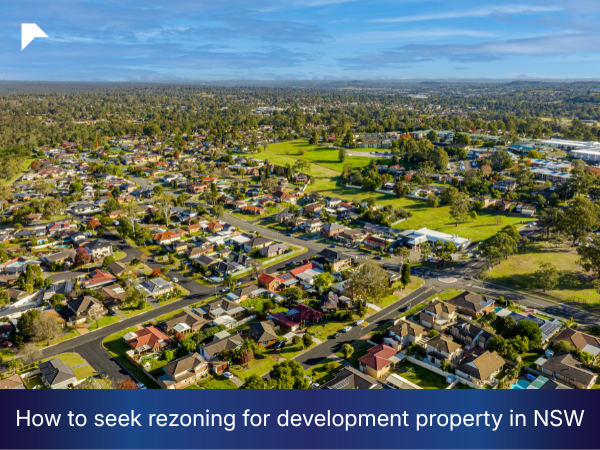
Rezoning can materially change what a site is worth - not because the land itself changes, but because the rules governing what can be built on it are altered.
A site zoned for industrial use may only support warehouses or low-intensity employment uses. The same site, if rezoned to mixed-use or residential, may support entirely different outcomes, including apartments, retail or higher-density development.
In New South Wales, rezoning is a structured planning process governed by the Environmental Planning and Assessment Act 1979, managed through a formal Planning Proposal process, and assessed by councils and the Department of Planning.
This guide explains what rezoning changes, how the NSW process works, what it typically costs, and the steps involved before and after approval.
What rezoning actually changes
Zoning defines the legal framework for land use. It determines what can be built on a site and influences key planning controls such as height limits, floor space ratios and parking requirements.
Landowners typically pursue rezoning for three reasons:
- To increase land value by enabling a higher-value use
- To unlock development potential not permitted under current controls
- To align zoning with broader strategic planning direction or housing demand.
For example, an industrial site rezoned to mixed-use may shift from warehouse use to residential apartments with active ground-floor retail. The uplift in value comes from the change in permitted use, not from physical improvements to the land itself.
The NSW rezoning process, step by step
In NSW, rezoning begins with a Planning Proposal, which can be prepared by a landowner, developer, council or the Minister for Planning.
Before lodgement, the existing Local Environmental Plan (LEP) and zoning controls must be reviewed in detail. The proposal must demonstrate planning merit for the change, not simply the potential development outcome.
The process generally includes four key stages:
- Planning rationale report: A formal justification for the rezoning, typically prepared by an urban planner. It explains how the proposal aligns with planning policy and local strategic frameworks.
- Supporting technical studies: Site-specific reports such as traffic, flood, heritage, environmental or infrastructure capacity assessments. These are often the most time-intensive and costly components.
- Community and stakeholder consultation: Informal engagement may occur early, but formal consultation takes place during the exhibition stage. Feedback can result in material changes to the proposal.
- Council assessment and Gateway determination: Council assesses the proposal and determines whether it proceeds to the Department of Planning through the Gateway process, often with conditions attached.
Pre-lodgement meetings with council planners are standard practice and are used to test feasibility before committing to full documentation. Poorly prepared or incomplete submissions are a common cause of delay.
The legal framework
Rezoning in NSW is governed by the Environmental Planning and Assessment Act 1979. A Planning Proposal can be refused at multiple stages of the process, and may also be challenged or opposed by stakeholders such as residents or community groups.
While landowners can request a rezoning, approval pathways are limited compared to standard development applications. Once a proposal is refused or altered, appeal options depend on the nature of the decision and are not always straightforward.
For complex or contested proposals, legal advice from a planning lawyer is often required.
What it actually costs
Rezoning costs vary significantly depending on site complexity, council requirements and the scope of supporting studies. Typical cost components include:
- Council fees: application and administration charges that vary with proposal complexity
- Planning consultant fees: preparation and coordination of the Planning Proposal through Gateway
- Specialist studies: traffic, environmental, heritage, flood and infrastructure reports
- Legal fees: advice on process, documentation and disputes where required
- Community consultation costs: engagement sessions, materials and facilitation.
The most common cost pressure point is not the initial scope, but additional requirements introduced during assessment. Councils may request further studies or expanded analysis after lodgement, extending both timeframes and budgets.
After approval
Rezoning does not allow development to begin immediately. It changes the planning controls for a site, but a separate Development Application is still required under the new zoning.
That application is assessed against the updated controls and may require further approvals such as construction certificates, subdivision approvals or infrastructure agreements, depending on the project.
Early and transparent engagement with the council and the community can help reduce objections at the development application stage, although it does not eliminate them.
Common misconceptions to avoid
Rezoning only takes a few months. In practice, NSW rezoning processes typically take six months to two years, depending on complexity and the extent of technical work required.
Early council support means approval is likely. Pre-lodgement feedback is advisory only. Proposals can still be refused later due to policy conflicts, technical issues or community objections.
The final word
Before submitting a Planning Proposal, investors should:
- Confirm current zoning and LEP controls
- Scope technical study requirements based on site constraints
- Engage with the council through a pre-lodgement meeting
Rezoning is a technical planning process with multiple assessment stages. It should be treated as a formal application, not a negotiation. Planning consultants and legal advisers with experience in the relevant council area are typically essential to navigating the process effectively.