

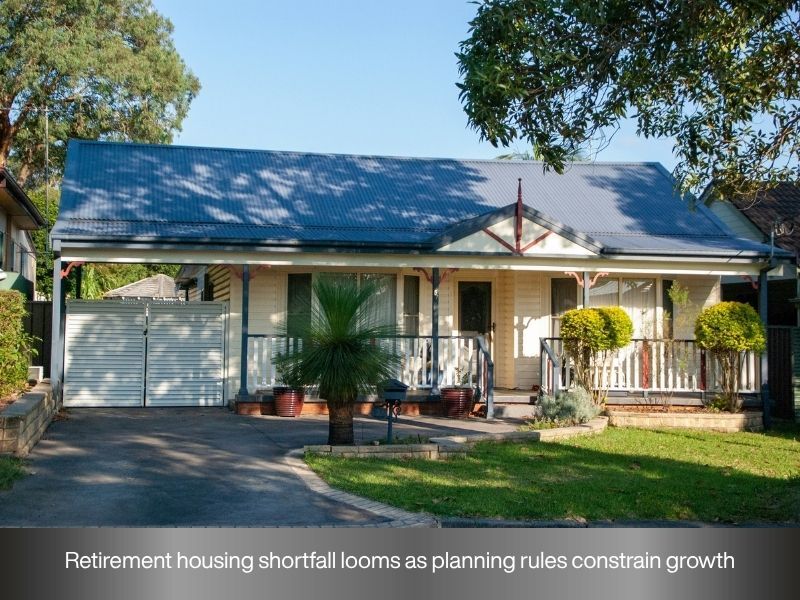
New research from Colliers estimates households aged 75 and over will grow by more than 1.2 million over the next two decades, creating demand for between 72,000 and 97,000 retirement living units nationwide.
However, the national delivery pipeline is currently tracking at around 2,000 units per annum - well short of the estimated 3,600 to 4,850 units required annually.
Colliers Healthcare & Retirement Living Head of Data Solutions, Lynn Johnsen, said a significant shortfall was emerging.
“If current delivery rates persist, Australia could face a cumulative shortage of 28,500 - 57,000 retirement village units over the next two decades,” Ms Johnsen said.
Metro markets are expected to face the greatest challenge.
“In Sydney alone, current trends point to a shortfall of up to 15,000 retirement village units in that same timeframe,” she said.
Demand concentrated close to home
The challenge is not just the scale of demand, but where it is occurring.
Colliers’ survey data shows most older Australians want to downsize within their existing communities, with the majority of moves occurring within 20km of the family home.
Access to healthcare, retail services, public transport and established social networks remain key factors influencing relocation decisions.
Ms Johnsen said demand for seniors living was highly location-specific.
“Most older Australians seek to age in the communities they already know and value, but in better-suited housing,” she said.
“Seniors’ housing options need to be made available where people already live, not where we hope they will relocate.”
Viable locations are shrinking
Meanwhile, the number of viable development opportunities is narrowing, according to Colliers’ analysis.
In Metro Sydney, more than 900 suburbs are reduced to fewer than 60 viable locations once planning feasibility, location quality, downsizer concentration and saturation risk are taken into account.
That concentration of viable sites, combined with rapidly growing demand, is intensifying competition for land and limiting the sector’s ability to respond where demand is strongest.
Colliers Urban Planning Director, Daniel West, said current planning settings were contributing to the challenge, with retirement living incentives failing to keep pace with those introduced for other housing types.
“Since then, other housing types, such as in-fill affordable housing, have received planning incentives that are significantly more generous than those for retirement living,” he said.
“This means that in high-density areas with strong housing demand, retirement living developers and providers are at a distinct disadvantage when attempting to acquire sites.”
Ageing villages locked out of renewal
The research also identifies a growing challenge within the existing retirement housing stock.
More than half of Metro Sydney’s retirement villages - about 16,000 dwellings - are located on land where zoning restricts redevelopment.
Around 30 per cent of these villages were developed before 1990.
Despite being capable of supporting higher-density outcomes, many cannot be feasibly renewed under current planning controls, leaving a growing pool of ageing accommodation unable to meet modern expectations.
Mr West said many older retirement villages were reaching the end of their economic life but were constrained by their location and existing planning controls.
“Typically, they are already near or at their development potential under the applicable zoning and planning controls, meaning there is little incentive to redevelop them,” he said.
“There are hundreds of examples of these older villages in NSW that are nearing the end of their economic life and no longer meeting market expectations of the current generation of people wanting to downsize.”
Broader housing impacts emerge
Without suitable downsizing options in their local communities, older Australians are more likely to remain in larger family homes, reducing the supply of housing available for younger households.
Ms Johnsen said retirement living played a much broader role than simply providing accommodation for older Australians.
“Retirement living is often viewed as a niche housing segment, but its impact is much broader,” she said.
“Enabling older Australians to move into well-designed, age-appropriate housing improves their quality of life while also freeing up existing housing stock and supporting greater efficiency across the entire housing market.”
Mr West said targeted planning incentives could help unlock the redevelopment of older retirement villages while supporting broader housing supply objectives.
“The proposition is for a floor space and height bonus to apply to existing retirement villages on sites greater than one hectare,” he said.
“The planning intent is to encourage scale and density centrally within the site, transitioning down adjacent to sensitive boundaries. This presents an enormous opportunity not only to renew these sites, but also to significantly increase the supply of modern retirement living that meets market expectations.”