

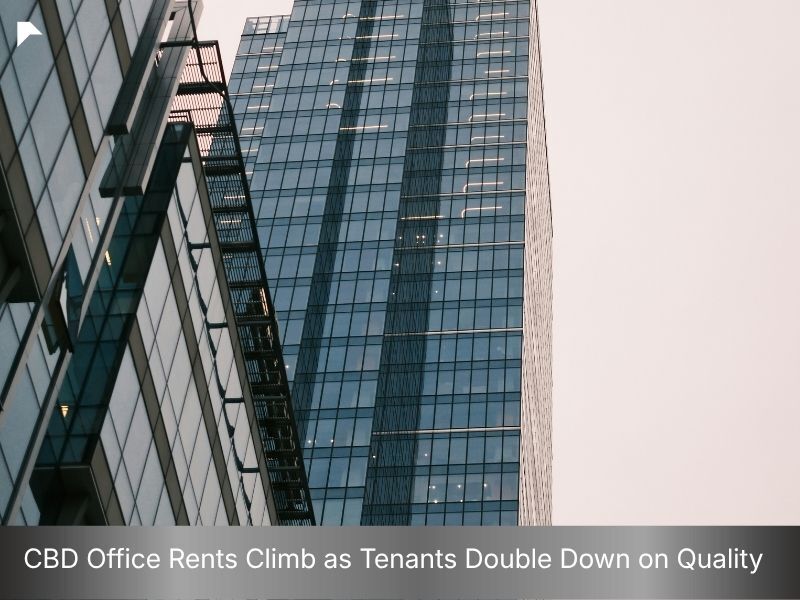
Australia’s major CBD office markets are recording some of their fastest rental growth in the post-pandemic period, and the gap between premium buildings and the rest of the market is widening.
According to Knight Frank’s Australian Office Indicators Q1 2026 report, Brisbane led the east coast, recording 11.7% annual net effective rental growth over the 12 months to the end of March. Sydney followed at 10.2%, with Melbourne posting 6.8%.
Knight Frank Senior Economist, Research & Consulting, Alistair Read, said rental growth was being driven by strong occupier demand concentrated in the highest-quality buildings, against a backdrop of a significantly thinning supply pipeline.
Tenants are also becoming acutely aware that the window to secure premium space is narrowing ahead of the supply slowdown.
“This is bringing forward leasing decisions and raising competition for the best-located buildings and driving strong rent growth in those precincts,” he said.
Australia Helps Lead APAC Recovery
The strong Australian performance is registering on the global stage.
Knight Frank’s Asia-Pacific Q1 2026 Office Highlights report shows prime net face rents across APAC rose 0.8% in Q1, with Australia and India among those leading the regional recovery.
Across the region, 18 of the 24 cities monitored reported stable or increasing rents quarter-on-quarter in Q1, up from 17 in Q4 2025.
The APAC recovery held through the quarter, even as the escalation of the conflict in the Middle East introduced fresh geopolitical uncertainty.
“Sydney and Brisbane are among the strongest-performing office markets across the entire Asia-Pacific region, with annual prime net face rent growth of 8.6% and 8.2% respectively - surpassed only by Bengaluru and Tokyo,” he said.
Premium Precincts Outperform
The headline growth figures understate what is happening at the top end of the market.
In Sydney’s Core precinct, net effective rents rose 14.3% over the past year, and in Melbourne’s Eastern Core the figure was 16.1% - both outperforming their broader CBD averages.
Core CBD rents are now 54% higher than non-core locations in Sydney, and 93% higher in Melbourne.
The gap reflects the growing premium occupiers place on amenity, accessibility and workplace quality.
Outside the CBDs, conditions remain subdued. Of the suburban markets, Melbourne’s Southbank has held up best, recording annual net effective rental growth of 2.7%.
“The ‘best and the rest’ thematic continues to prevail, with a focus on high-quality, well-located premises that have the best amenity for employees, if not on the doorstep, then immediately adjacent in the precinct as employers look to attract and retain talent,” Mr Read said.
Supply Constraints Keep Outlook Firm
Mr Read said the Middle East conflict had introduced uncertainty for investors, and the prospect of higher interest rates also presented near-term challenges.
However, the fundamentals underpinning Australia’s office markets remain intact.
The supply pipeline is thinning, and interest rates are expected to trend lower toward 2027-28.
“Economic rents remain well above the levels needed to justify new construction, and this could worsen as the Middle East conflict raises the cost of construction materials, potentially delaying new projects and extending the supply constraint,” he said.
“This should support relatively strong rental growth over the medium term.”